
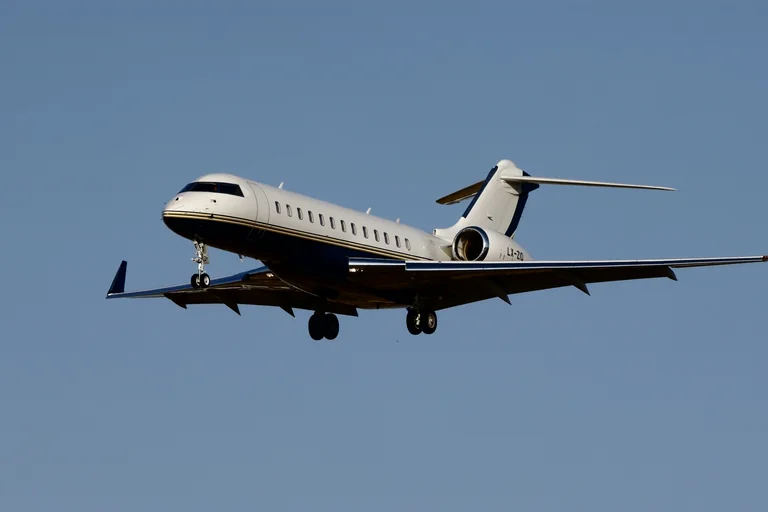





A London to New York sector looks straightforward on a map. In private aviation, the aircraft decision can change with the wind, passenger count, baggage, airport pair and how much time you intend to spend on board. The best jets for transatlantic flights are not simply those with the longest published range. They are the aircraft that give the right margin for the actual brief, without paying for capability you will not use.
For a principal travelling from Farnborough to Teterboro with three colleagues, a super-midsize jet may be viable on the right day. For a family leaving London after a late meeting, carrying ski equipment or travelling onward from New York, an ultra-long-range cabin is usually the more controlled answer. The distinction matters most westbound, where headwinds can turn a nominally comfortable routing into a fuel stop or a compromise on payload.
The best jets for transatlantic flights are chosen by mission
Published range is a useful starting point, but it is not a dispatch promise. Manufacturer figures are normally based on defined assumptions: selected cruise speeds, a restricted passenger load and favourable atmospheric conditions. A charter operation has to account for forecast winds, alternate airports, runway performance, baggage volume, catering, crew duty limits and the preferred arrival time.
London-New York is roughly 3,000 nautical miles depending on airports and routing. Eastbound, aircraft often benefit from strong tailwinds. Westbound is the test. London-Miami, London-Los Angeles via a technical stop, Paris-New York and Dubai-New York each require a different calculation.
For that reason, the most suitable aircraft is often selected after the routing is checked in real time, rather than from a static range chart. The following aircraft sit at the top end of the charter market for Atlantic work, each for a different reason.
| Aircraft | Published maximum range | Typical layout | Best suited to |
|---|---|---|---|
| Bombardier Global 8000 | 8,000 nm | Up to 19 passengers | Non-stop range with the widest operating margin |
| Gulfstream G700 | 7,750 nm | Up to 19 passengers | Large groups, long sectors and a refined cabin programme |
| Bombardier Global 7500 | 7,700 nm | Up to 19 passengers | Clients prioritising a proven four-zone cabin |
| Gulfstream G650ER | 7,000 nm | Up to 19 passengers | Fast, established long-range transatlantic flying |
| Dassault Falcon 8X | 6,450 nm | Up to 14 passengers | Flexible airport access and efficient long-range missions |
| Embraer Praetor 600 | 4,018 nm | Up to 12 passengers | Smaller parties on London-New York missions, conditions permitting |
| ACJ TwoTwenty | 5,650 nm | Up to 19 passengers | Delegations wanting airliner-derived cabin volume |
Ranges are manufacturer-published maximum figures and should be treated as planning references, not guaranteed non-stop performance.
Global 8000 and G700: maximum margin, minimum compromise
For clients who want to remove uncertainty from the equation, the Bombardier Global 8000 and Gulfstream G700 are the leading choices. Both are designed for sectors far longer than a standard transatlantic crossing, leaving meaningful room for adverse winds, full baggage loads and conservative fuel planning.
The Global 8000 is the aircraft to consider when range margin is the priority. It is particularly relevant for westbound departures, multiple passengers with substantial luggage, or a schedule where an unplanned technical stop is simply not acceptable. Its large-cabin format also works well when the journey is part office, part rest period and part family travel. Separate zones allow a principal to work privately while others eat, sleep or watch a film without sharing one open cabin.
The G700 has a similarly commanding range profile, with a high-speed cruise capability that can be valuable when a late departure needs recovering. Its cabin can be configured across multiple living areas, including a private rear suite on certain layouts. For a group travelling between London, New York, Miami and the Middle East, it is a highly capable all-round platform.
Neither option is necessary for every Atlantic trip. They attract a premium in charter pricing, and their size can limit access at certain smaller airports. But when the brief includes significant time pressure, complex baggage or onward intercontinental flying, their additional capability is operational insurance rather than excess.
Global 7500 and G650ER: proven flagships for Atlantic routes
The Global 7500 remains one of the most requested aircraft in private aviation. Its four true cabin zones set it apart for passengers who intend to use the flight properly: an entrance or dining area, a working space, an entertainment lounge and a separate sleeping area. On a six- to eight-hour westbound sector, that separation has real value.
Its range makes London to New York, Boston, Washington, Toronto and Miami routine missions, with significant flexibility beyond them. The aircraft is also a strong choice for a principal travelling with security, assistants, children or colleagues, where everyone needs a defined place rather than an upgraded seat.
The Gulfstream G650ER remains equally relevant. It is fast, familiar to experienced charter clients and available through a broad global operator base. The cabin is slightly more linear in feel than the Global 7500, but it remains spacious, quiet and well set up for work or rest. For a London-New York return, especially where speed and a recognised flagship aircraft matter, it is difficult to fault.
The deciding factor between the two is often cabin preference and availability, not headline performance. A well-maintained G650ER positioned at the right airport may be the better answer than a Global 7500 requiring an expensive repositioning sector or an inconvenient departure slot.
Falcon 8X: the discreet, capable alternative
Dassault's Falcon 8X offers a different form of capability. With three engines, excellent range and strong short-runway performance, it can be particularly attractive where the trip begins or ends at an airport less accommodating to larger ultra-long-range aircraft.
It does not offer the same cabin volume as a Global or G700, but that is not always a drawback. For six to 10 passengers, the 8X feels composed rather than oversized. It is a serious transatlantic aircraft for London to New York, Boston, Montreal and many other North American routes, while retaining the flexibility to use airports that can be less practical for larger rivals.
For principals who value understatement, it is also a compelling choice. The Falcon 8X delivers long-range performance without making the aircraft selection feel performative.
Praetor 600: when a smaller jet makes sense
The Embraer Praetor 600 deserves consideration for a specific type of trip: a small party travelling on a core North Atlantic route with a flexible schedule and sensible baggage requirements. It can be an intelligent alternative to a heavy jet where conditions support a non-stop flight, particularly between London and the North-East United States.
Its limitation is margin. A full cabin, a large volume of luggage, stronger-than-forecast westerlies or a longer diversion requirement can alter the plan. A fuel stop is not automatically a failure, but it changes the value proposition when time is the reason for chartering.
This is where independent aircraft sourcing matters. The right adviser should not force a smaller aircraft because it is available, nor default to the largest option because it is easier to sell. The question is whether the aircraft protects the mission on the day you travel.
ACJ TwoTwenty: cabin space for delegations and families
The ACJ TwoTwenty is for travellers who need more than a large-cabin jet can comfortably provide. Based on the Airbus A220 platform, it brings airliner-derived width and volume to private operations, with space for distinct work, dining, lounge and rest areas.
It is not the default answer for a couple travelling to Manhattan. It comes into its own for delegations, extended families, touring parties and management teams that need room to work together. The range comfortably supports major transatlantic routes, while the cabin feels closer to a private residence than a conventional business jet.
Availability is naturally more limited than for established ultra-long-range types, so it suits planned missions more than last-minute point-to-point requests. Where it fits, however, it solves a very different problem from the usual flagship jet.
What to confirm before selecting the aircraft
The aircraft type is only one part of the decision. Ask for the specific tail number, cabin configuration, age of refurbishment, onboard Wi-Fi performance and whether the operator has experience on your exact route. For overnight westbound travel, establish how many passengers can sleep flat without converting the entire cabin. For a family trip, check baggage volume rather than relying on a generic allowance.
Airport selection deserves equal attention. Farnborough, Biggin Hill and Luton each offer different advantages for London departures. In the New York area, Teterboro is often the practical choice, but White Plains, Newark and JFK may suit the final destination, aircraft size or arrival schedule better. Ground transfers, border formalities and departure slots should be handled as part of one plan.
The 0.1% Group sources independently across the charter market, so the recommendation begins with the route, timing and passenger requirements rather than a fleet to fill. Real timelines, live aircraft positioning and payment requirements, including major cryptocurrencies and stablecoins, can then be considered in confidence.
For an Atlantic crossing, the most useful question is not which jet has the biggest number beside its range. It is whether the aircraft can leave when you need, arrive where you need and preserve the privacy, rest and control that made private aviation the right choice in the first place.