


Private jet cabin layouts are not a cosmetic detail. They determine whether a four-hour sector becomes protected working time, a proper night’s rest, a discreet family journey or an unnecessarily cramped compromise. Two aircraft can carry the same number of passengers on paper and deliver entirely different experiences in the air.
For charter clients, the right question is rarely, “What is the nicest jet?” It is, “What must this aircraft allow us to do between departure and arrival?” A board meeting, a sleeping principal, a travelling family, a security detail and a delegation each require a different cabin. One contact should establish that before aircraft options are presented.
Why private jet cabin layouts matter
A cabin layout governs three things: usable space, privacy and operating practicality. Seat count matters, but it is only one part of the brief. A light jet configured for seven may be entirely suitable for three adults with soft luggage. It may be the wrong choice for six adults travelling with golf bags, garment cases and the expectation of a proper meal.
The difference becomes more pronounced on longer sectors. On a London to Dubai flight, an open club cabin with a divan may be ideal for an executive team working together. On an overnight crossing to New York, that same layout may offer too few genuinely flat sleeping positions. The aircraft can complete the route, yet the journey may not serve the people on board.
Charter aircraft are also not identical within a type. Refits, operator specifications and maintenance schedules can produce meaningful variation. One Global may have a forward crew rest, a four-place conference grouping and a private aft stateroom. Another may prioritise a larger lounge, more upright seating or different entertainment equipment. The cabin plan must be confirmed for the specific tail offered, not assumed from a brochure image.
The four cabin zones that shape the journey
The forward cabin: arrival and first impressions
The forward section is usually closest to the entry and galley. In many super-midsize and large-cabin aircraft, it is arranged as a club of four facing seats, sometimes with a folding table. It works well for a principal travelling with advisers, a family wanting to remain together, or colleagues who need to talk without formal ceremony.
Its limitation is traffic. Crew access, catering preparation and passenger movement all tend to pass through this area. If privacy is non-negotiable, the principal is often better placed in an aft zone rather than seated at the front throughout the flight.
The conference area: work that needs a table
A conference grouping provides more than a place to eat. It gives a team a usable setting for documents, laptops and confidential conversation. Depending on the aircraft, this may be four opposing seats around a table, or a dedicated dining and meeting zone separated from the main lounge.
For a senior executive travelling with three or four colleagues, this can be more valuable than extra passenger capacity. It is worth checking table dimensions, power provision, connectivity capability and whether the seating remains comfortable once the table is deployed. A nominal conference layout is not always practical for a long working session.
The lounge: social space and flexibility
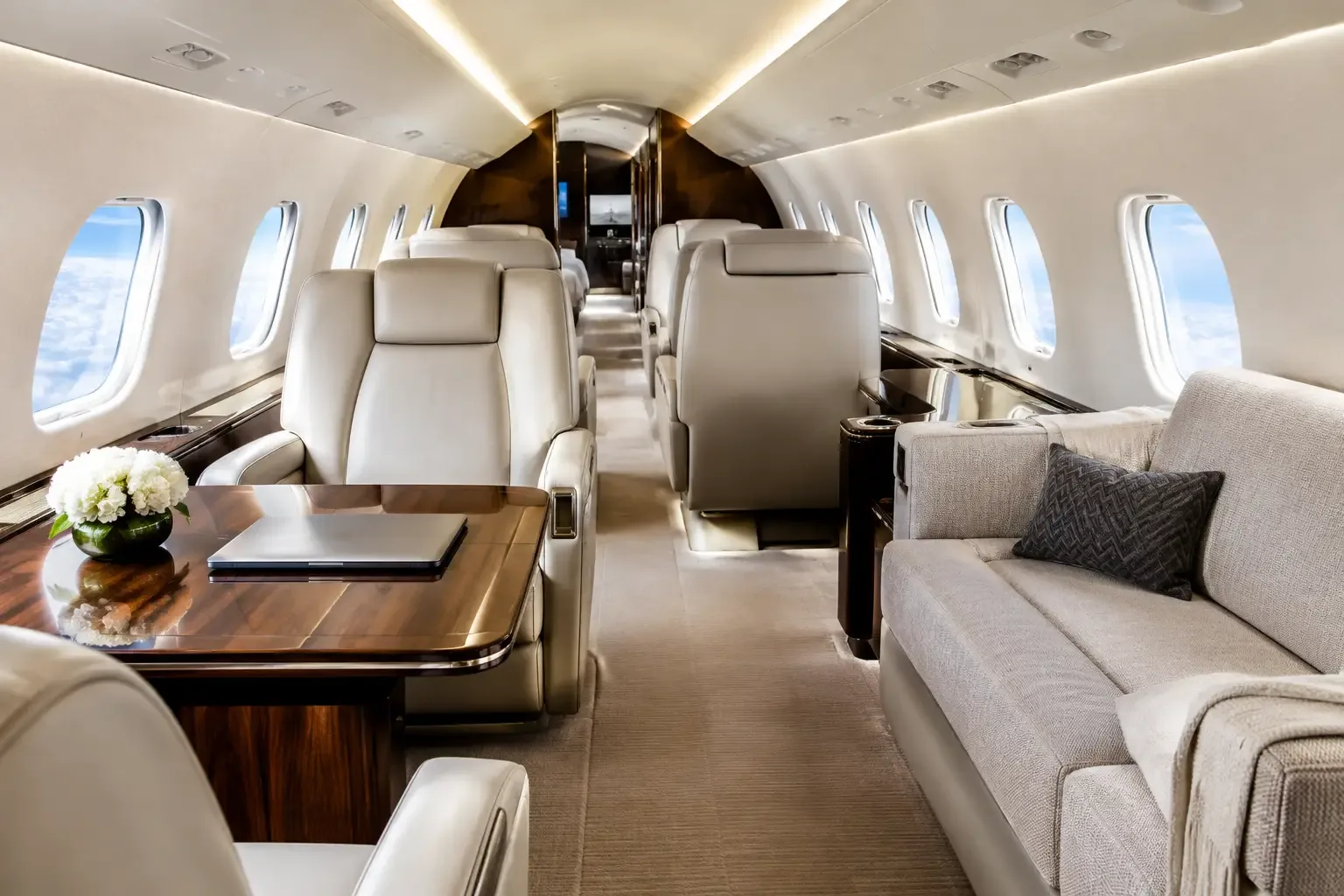
The lounge is the most adaptable part of many private jet cabin layouts. It may combine club seats, a side-facing divan and occasional seats, creating a relaxed setting for conversation, dining or family travel. On larger aircraft, it can function as an informal reception area before passengers move to more private zones.
A divan adds useful flexibility but should not be counted automatically as a bed. Its length, width and position vary substantially. It may suit a child, a short rest or an additional seated guest, but it does not necessarily replace a lie-flat bed for an adult on an overnight flight.
The aft cabin: privacy, rest and control
For many principals, the aft cabin decides the aircraft. A fully enclosed rear suite offers separation from colleagues, family members and crew activity. In the best long-range configurations, it may include a fixed bed, a private lavatory and direct access to a wardrobe or dressing area.
This is particularly relevant for red-eye travel, back-to-back meetings on arrival and journeys where a principal needs to remain out of view. An enclosed aft section is not only about luxury. It allows one person to rest while the rest of the cabin continues to work or dine without disrupting them.
Matching the cabin to the aircraft category
Light jets are efficient for short European sectors, typically accommodating four to six passengers comfortably depending on baggage and individual expectations. Their cabins are designed around speed and access rather than multiple zones. They suit a short London to Geneva or Paris movement well, particularly where the group is small and the day is tightly scheduled.
Midsize and super-midsize jets introduce greater stand-up room, a more capable galley and, often, a distinct meeting area. They are a strong option for transcontinental European travel, Middle East sectors and executive groups that need enough space to work without moving into a large-cabin aircraft. Some offer lie-flat seating, but the number of credible sleeping positions should always be checked.
Large-cabin and ultra-long-range aircraft are built for zoning. Aircraft in this category can separate work, dining, social space and sleep, usually with more generous baggage capacity and a better onboard service environment. For London to Los Angeles, Dubai to New York or multi-leg international travel, the ability to close a door between the principal and the wider group changes the quality of the journey.
VIP airliners sit in a different category altogether. They are appropriate where a delegation, entourage or extended family needs volume, multiple lounges and private rooms rather than simply more seats. They can be configured with boardrooms, bedrooms, dining rooms and staff areas. They are not automatically the right answer, however: airport access, passenger numbers, route economics and ground handling all need to justify the scale.
Seat count is not sleeping capacity
This is one of the most expensive assumptions in private aviation. An aircraft advertised for 13 passengers may have only four or five beds that are genuinely suitable for a full night’s sleep. Reclining club seats, divans and belted lavatories can increase the certified passenger figure, but they do not provide equal comfort.
For overnight missions, request a clear sleeping plan: who has a fixed bed, who has a lie-flat berth, and who is expected to rest in a reclined seat. If eight passengers need to arrive rested, an aircraft with eight proper sleeping positions should be prioritised over one with a more impressive headline capacity.
The same discipline applies to daytime travel. Nine passengers may fit physically, but a cabin becomes less useful when every table is occupied, coats and hand luggage are competing for space, and no quiet seat remains for a confidential call. The right layout has breathing room built into it.
Details that change the experience
Lavatory placement can be decisive. A private aft lavatory protects a principal’s suite and prevents guests from moving through the sleeping area. On smaller aircraft, the lavatory may be compact or partly exposed to the cabin, which is perfectly workable for a short sector but less appealing on a longer journey.
Galley specification also varies. A fully equipped galley and experienced cabin crew can support plated dining and tailored catering. A smaller galley may be limited to cold service, heating selected dishes or simple refreshments. If a working lunch, dietary programme or specific service standard matters, it should be briefed before the aircraft is confirmed.
Then there is luggage. Ski equipment, couture, children’s equipment, golf clubs, security cases and large instrument cases can alter the aircraft decision quickly. Internal access to baggage during flight is useful, but not universal. For a multi-stop itinerary, the loading plan matters as much as the cabin plan.
How to brief the right cabin
A useful charter brief starts with the route and passenger count, then moves beyond both. State whether the flight is daytime or overnight, whether anyone must sleep properly, who needs to work together, and whether the principal requires a separate area. Include catering expectations, luggage profile, travelling staff and any security considerations.
It also helps to identify what cannot happen. Perhaps the principal cannot sit near a particular guest. Perhaps a family needs children to settle away from a working parent. Perhaps a delegation requires a table for six, or a watch case and personal luggage must remain under close control. These details allow the sourcing process to eliminate unsuitable aircraft early.
The 0.1% Group handles this as an operational brief rather than a generic seat request: specific aircraft, confirmed cabin plans and real availability, handled in confidence.
Before accepting an aircraft, ask to see the actual cabin configuration, not just the type name. A few minutes spent checking bed positions, door placement, table layout and baggage access can protect an entire itinerary. The best cabin is the one that lets every person on board arrive ready for what happens next.