Which Richard Mille tourbillons come in sapphire, and why there are so few.
Richard Mille grows its sapphire with its Swiss partner Stettler AG by the Kyropoulos method, heating aluminium oxide to between 2,000 and 2,050 °C. One curved three-part case needs a block weighing several dozen kilos and, Richard Mille says, more than 1,000 hours of milling and polishing. Coloured sapphire is harder again, because metal oxides have to be worked into the crystal as it grows.
The first was the RM 056 split-seconds chronograph tourbillon of 2012, five pieces in clear sapphire. The RM 56-01 of 2013, also five, added a sapphire baseplate, and the RM 56-02 of 2014, ten pieces, hung its movement on a single 0.35 mm cable. Blue came later: the cable-suspended RM 53-02 of about 2022, ten pieces by Richard Mille's count, and a blue RM 75-01 Flying Tourbillon in 2025, made in clear, blue and lilac sapphire. The RM 57-03 Sapphire Dragon of 2019 had five sapphire cases among its 55.
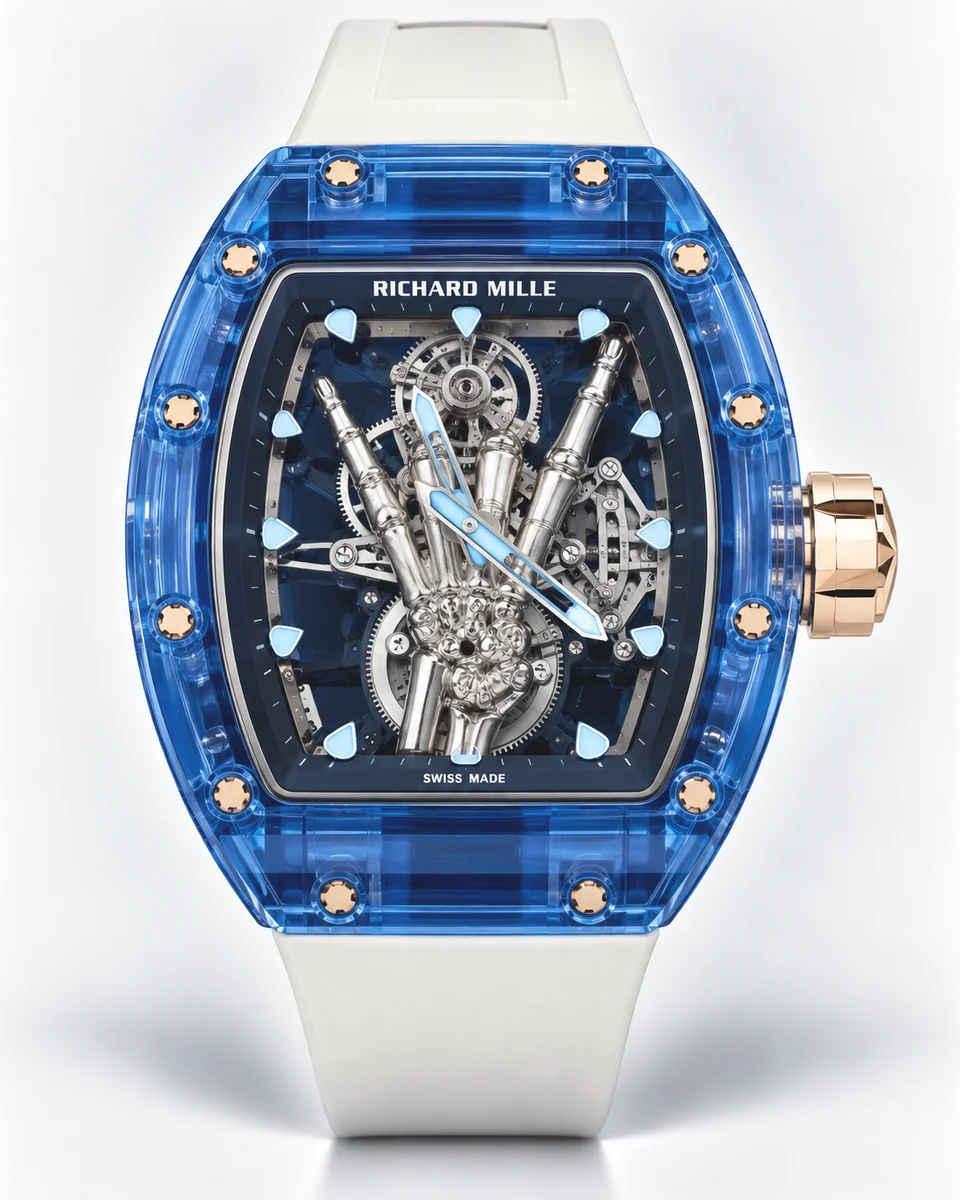
The watch in our photograph has a blue sapphire case and a skeleton hand across the dial with the tourbillon at twelve, a layout that recalls the RM 66 Flying Tourbillon. A sapphire RM 66 is reported by dealers but not by Richard Mille's own pages, so we do not name a reference for it. Tell us what you have seen, or what you want from the case, and we come back with the references that fit and what is realistically findable.
- Sapphire grown by the Kyropoulos method and machined for over 1,000 hours
- Clear sapphire from 2012; blue on the RM 53-02 and RM 75-01
- Series of 5 to 15, so the reference is agreed before the search
- Sourced to your brief; availability confirmed for each request