




A party of 12 can be easy to accommodate on paper and surprisingly difficult to accommodate well. The question is not only which jet fits twelve passengers, but whether all 12 can work, dine, rest and travel with the luggage they actually intend to bring. A jet that is technically certified for 12 may be the wrong aircraft once golf bags, ski cases, security, staff, pets or a transatlantic sector enter the brief.
For most private charter requests, 12 passengers places the group at the boundary between super-midsize and large-cabin aviation. The right answer depends on route length, cabin use, baggage volume and the level of privacy expected. Seat count is only the starting point.
Which jet fits twelve passengers comfortably?
For flights of up to around four hours, a super-midsize aircraft can work well when the group is travelling light. The Citation Longitude, Challenger 3500 and Gulfstream G280 are credible options, usually seating eight to 10 in their standard executive layouts, with some charter configurations accommodating up to 12.
That distinction matters. A cabin configured for 12 may include a side-facing divan, belted lavatory or more closely spaced seats. This is entirely practical for a London to Ibiza, Paris to Nice or Dubai to Riyadh sector, particularly when the passengers know one another and the flight is principally about getting there quickly. It is less convincing for an all-day journey or a board-level working flight.
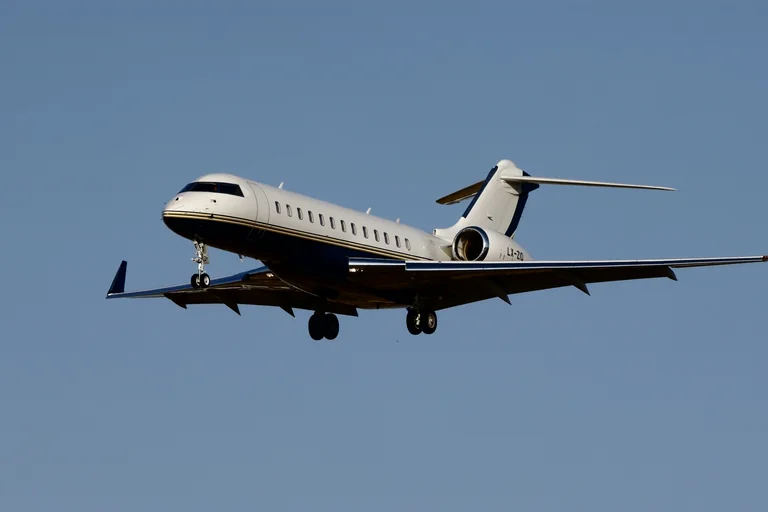
For a group of 12 travelling in the way private aviation is meant to feel, a large-cabin aircraft is normally the better starting point. The Bombardier Challenger 650, Embraer Praetor 600 in a favourable layout, Gulfstream G450 or G550, and Dassault Falcon 900 series offer more room to move, a better galley, stronger baggage capability and a proper sense of separation within the cabin.
The Challenger 650 is particularly well suited to European and Middle Eastern group travel. It typically carries 10 to 12 passengers in a wide, comfortable cabin, with generous baggage provision and dependable short- and medium-haul performance. For a delegation flying London to Athens, Geneva to Dubai or Milan to Doha, it is often the sensible answer rather than the flashy one.
The route determines the aircraft category
Distance changes the conversation quickly. A 12-person group travelling from Farnborough to Mallorca has a far wider aircraft choice than one travelling from London to New York or Dubai to Los Angeles.
For European flights and regional Middle East sectors, super-midsize and large-cabin aircraft are both viable. A Citation Longitude may be sufficient for a daytime flight under three hours with soft luggage. A Challenger 650 or Falcon 900 provides a more relaxed experience if the group includes families, multiple generations or executives who need space to prepare before arrival.
For transatlantic travel, the aircraft must have the range to operate the route with sensible payload margins. A Gulfstream G550, G650, Bombardier Global 6000, Global 6500 or Global 7500 is the more appropriate category for 12 passengers, depending on the exact route and prevailing winds. These aircraft are designed for long sectors, with multiple cabin zones, lie-flat sleeping arrangements, larger galleys and luggage holds that do not become a negotiation at the ramp.
A London to New York flight may be possible in several large jets, but that does not mean every option will deliver the same cabin experience. If 12 passengers are aboard with full-size cases, cabin crew, catering and a requirement for uninterrupted rest, an ultra-long-range aircraft offers more operational margin and substantially more comfort.
Non-stop capability should never be treated as a promise based solely on brochure range. Weather, routing restrictions, runway performance, alternate airport requirements and passenger load all affect what is possible on the day. Real timelines come from a live request, not a generic range figure.
Cabin layout matters more than a maximum seat number
Two aircraft with a stated 12-seat capacity can feel completely different. One might offer a four-seat club, conference grouping and divan. Another may have 12 individual seats but little room for people to pass, hold a private call or lay out a working lunch.
For executive groups, look for a cabin with defined zones. A forward club section allows meetings and conversation; a separate dining or conference area supports documents and catering; an aft section gives principals or family members a quieter space. On an overnight sector, sleeping positions become more relevant than the number of upright seats.
If discretion is central to the trip, cabin zoning also protects privacy. A principal can work at the rear while colleagues, close protection or support staff occupy the forward cabin. On some larger Gulfstream and Global aircraft, a separate crew rest area and enclosed aft cabin improve the experience further.
Ask for the specific aircraft registration and interior layout before confirmation. Aircraft type alone is not enough. The same model can be configured with different seat counts, divans, galley equipment, Wi-Fi capability and baggage compartments. A good charter brief identifies who is travelling and how they need to use the cabin, not just how many names are on the manifest.
Baggage is where many 12-passenger charters fail
Twelve passengers travelling for a weekend in the south of France are not the same as 12 passengers travelling to St Moritz for a week, carrying formalwear, ski equipment and multiple cabin cases. Nor are they the same as a music entourage, an investment team travelling with presentation equipment or a family with pushchairs and pets.
Most large-cabin aircraft can handle normal luggage for 12 passengers with relative ease. The complication comes with oversized items and hard cases. Golf clubs, skis, garment trunks, camera equipment and security equipment need to be declared early. Some baggage holds are accessible during flight; others are not. That can matter on a multi-sector day when a change of clothes, medication or important documents must remain in the cabin.
Where luggage volume is substantial, it can be better to move up an aircraft category rather than force the group into a technically possible solution. Alternatively, a separate support aircraft or dedicated baggage logistics can protect cabin comfort and avoid last-minute compromises. The right answer is often more economical than booking an oversized jet for every sector, particularly on complex itineraries.
When a VIP airliner is the better answer
Once the group reaches 12, it is worth considering whether the party is likely to grow. A 12-person booking can become 16 after assistants, family members, close protection and business partners are added. If the journey includes a large amount of luggage or the principal expects a lounge-style environment, a VIP airliner may become the more rational choice.
An Airbus ACJ or Boeing Business Jet provides far greater cabin volume, usually with separate lounge, dining, bedroom and meeting areas. They are not the automatic answer for 12 people. Their operating cost, airport limitations and handling requirements are materially different. Yet for a high-profile delegation, a touring party, a major sporting schedule or a family office moving between continents, the additional space can remove operational friction entirely.
There is also a middle ground. A high-capacity regional airliner in VIP or business configuration can be appropriate for short-haul group movements where privacy matters but ultra-long-range capability does not. The decision should be based on the whole itinerary, not one headline sector.
A practical aircraft shortlist for 12 travellers
The following is a useful starting point, subject to the individual aircraft layout and live availability:
- Citation Longitude or Challenger 3500: best for shorter routes, lighter luggage and groups willing to accept a more compact cabin.
- Challenger 650 or Falcon 900: strong choices for Europe, the Middle East and medium-range sectors where 12 passengers need genuine comfort.
- Gulfstream G550, Global 6000 or Global 6500: suited to long-range executive travel, larger baggage loads and cabins requiring clear working and resting zones.
- Gulfstream G650, Global 7500 or Falcon 8X: appropriate for demanding non-stop missions, overnight travel and principals who expect space without compromise.
- ACJ or BBJ: reserved for larger delegations, complex support requirements or journeys where the cabin itself must function as a private residence and office.
How to brief a 12-passenger charter properly
The fastest way to receive an accurate aircraft recommendation is to provide the full operating picture at the outset: departure and arrival airports, preferred timings, all passenger numbers including staff, luggage profile, pets, catering requirements and whether the cabin will be used for meetings, sleep or privacy.
Be clear about what cannot be compromised. For some clients, it is a non-stop sector. For others, it is an enclosed sleeping area, unrestricted Wi-Fi, a specific departure terminal or the ability to bring bulky luggage. These priorities determine the aircraft more reliably than a target budget alone.
The 0.1% Group sources against the actual brief rather than steering clients towards a fixed fleet. That means the recommendation can change if the route, passenger profile or ground arrangements change. One contact can also coordinate the connected details: chauffeur movements, airport handling, villa arrival, security, catering and payment in major cryptocurrencies or stablecoins, all handled in confidence.
For 12 passengers, the best jet is rarely the smallest aircraft that can legally carry the group. It is the one that lets every traveller arrive composed, on time and without discovering the limitations of the cabin at 40,000 feet.