




A London to Riyadh departure for six principals is rarely the same brief as moving a 35-person leadership team, close protection detail and production equipment to Miami. That is where the heavy jet versus VIP airliner decision becomes practical rather than aspirational. Both offer privacy, direct routing and control over the journey. The right aircraft depends on who is travelling, how they need to work or rest, what must travel with them, and what the schedule can absorb.
For most private flights, a heavy jet is the decisive answer. A VIP airliner becomes relevant when the passenger list, cabin requirement or logistical complexity outgrows the business-jet category. Choosing larger simply because it appears more impressive can create unnecessary cost, airport restrictions and longer ground handling. Choosing too small can make an otherwise important trip feel compromised before the aircraft has left the stand.
Heavy Jet Versus VIP Airliner: The Core Difference
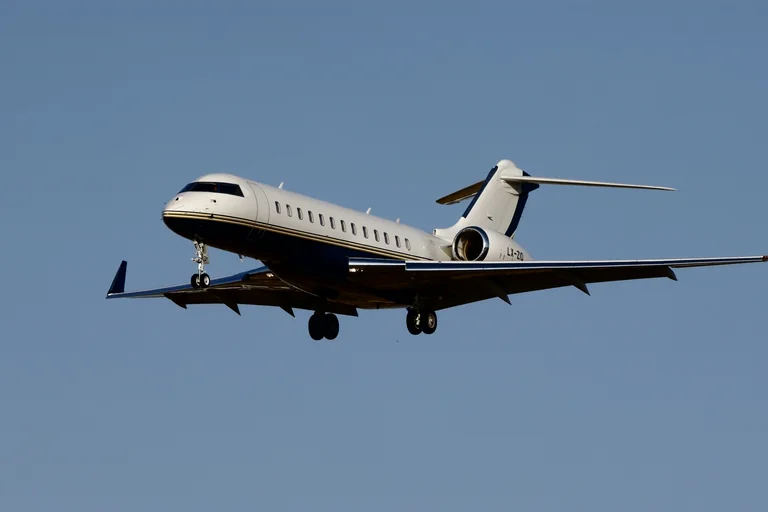
A heavy jet is a large-cabin business aircraft designed around long-range private travel for roughly 10 to 16 passengers, depending on the specific layout. Aircraft in this category can include the Gulfstream G650 or G700, Bombardier Global 7500 and Dassault Falcon 8X. They are built for non-stop intercontinental missions, with proper lie-flat sleeping, enclosed lavatories, substantial baggage capacity and a cabin quiet enough for confidential meetings.
A VIP airliner is a commercial airliner converted or configured for private use. Typical options include the Boeing Business Jet, Airbus ACJ320 family, Airbus ACJ330 or, for the largest requirements, wide-body Boeing and Airbus aircraft. Cabin layouts vary materially. One aircraft may be fitted for 19 guests in a flat-style interior with a bedroom, shower and boardroom; another may carry 40 to 70 passengers in a high-specification executive configuration.
The distinction is not simply seat count. A heavy jet gives a small group speed, access and a familiar private-aviation rhythm. A VIP airliner functions more like a private headquarters in the air. It can accommodate separate guest, staff and security zones, larger catering operations, medical support, media equipment or a full delegation without forcing everyone into one cabin.
When a Heavy Jet Is the Better Call
For principals, families and executive groups, the heavy jet remains the most efficient private charter solution. Its range is often sufficient for routes such as London to Dubai, New York to London, Paris to Los Angeles or Riyadh to the Maldives, subject to winds, payload, routing and the individual aircraft’s performance. A Global 7500 or Gulfstream G700 can cover many of these sectors non-stop with a meaningful passenger load.
Cabins are deliberately designed for a small number of people who value privacy over scale. A typical heavy jet offers three or four distinct zones: a forward galley and crew area, a meeting or dining space, a lounge and an aft private suite. On overnight sectors, the ability to sleep properly without sharing a cabin with a wider delegation matters more than an additional row of seats.
Heavy jets also have a major operational advantage: airport access. They can use far more private terminals and secondary airports than VIP airliners. This can mean departing closer to home, avoiding congested commercial hubs and arriving near an estate, yacht berth, resort or private meeting location. For a principal travelling from Farnborough, Luton, Biggin Hill or Paris Le Bourget, that flexibility is often worth more than extra cabin square footage.
They are generally quicker to position, easier to secure at short notice and less demanding on ground infrastructure. Availability still varies by date and geography, particularly around Formula 1 weekends, major sporting fixtures, Eid, Christmas and the summer Mediterranean season. Yet a heavy jet has a far deeper global charter pool than a private airliner.
When a VIP Airliner Earns Its Cost
A VIP airliner makes commercial sense when a heavy jet would require multiple aircraft or would leave too little room for the actual brief. It is not merely an upgrade. It is a different operating model.
A 25-person board group travelling with assistants, security, luggage and presentation equipment may technically fit across several large jets. But splitting the party introduces separate flight crews, staggered arrivals, fragmented security and multiple transfer arrangements at each end. One airliner keeps the group together and turns the flight into usable time.
For delegations, touring parties and family-office travel, separation within the cabin is equally valuable. Senior guests can occupy a private forward lounge while staff work or rest in another zone. A dedicated meeting room can be configured away from dining and sleeping areas. Larger galleys support more elaborate service, and the hold can take serious quantities of luggage, wardrobes, equipment and supplies without turning baggage planning into a negotiation.
VIP airliners are also appropriate where the aircraft itself is part of the requirement: diplomatic movements, high-profile tours, product launches, sports teams, music productions and large-scale incentive travel. In these cases, the capacity to carry people and mission-critical equipment on one schedule can outweigh the higher charter cost.
There are trade-offs. A VIP airliner requires suitable runway length, parking, handling equipment, crew coordination and, at some airports, advance approvals that a business jet would not need. Airport slots can be more restrictive. Turnaround times are longer. Some secondary airports are unavailable altogether. The largest cabin is of little value if it cannot operate into the destination that makes the trip work.
Range, Payload and Cabin Reality
Published range figures are useful, but they do not decide a mission on their own. They are usually expressed under defined assumptions, not necessarily with your full passenger count, golf bags, ski equipment, security team, catering request and prevailing winds.
An ultra-long-range heavy jet may advertise a range of 7,000 nautical miles or more. On the right routing, that can support an exceptional number of non-stop city pairs. But a full cabin, hot-weather departure, high-altitude airport or strong headwinds can change fuel and payload calculations. A technically possible route may still be better with a planned fuel stop if it protects comfort, baggage allowance or operational margins.
The same principle applies to VIP airliners. Their size does not make them operationally limitless. A narrow-body ACJ or BBJ can offer substantial range and cabin volume, but it will not replicate the endurance of a long-range wide-body. Conversely, a wide-body can carry far more people and cargo, but may be unnecessary for a party of 18 whose real priority is landing at a smaller airport near their final destination.
Cabin plans must be checked aircraft by aircraft. ‘VIP airliner’ can describe radically different interiors, from executive seating to a full private residence. Ask how many genuine beds are available, whether the bedroom is enclosed, how many lavatories are fitted, whether there is a shower, where crew rest is located and how passenger zones are separated. On a 10-hour night flight, these details are not cosmetic.
Cost: Look Beyond the Hourly Figure
A heavy jet is normally less expensive to charter than a VIP airliner, but a headline hourly rate does not tell the whole story. Positioning, airport charges, crew overnight costs, de-icing, international permits, catering, Wi-Fi, ground transport and aircraft parking can all shape the final figure. A one-way request may attract repositioning costs if the aircraft needs to return empty or move to its next charter.
With VIP airliners, handling and operational planning become a larger part of the cost base. More crew may be required, and airport infrastructure can carry higher charges. The aircraft may also need to position from another region because the supply of privately configured airliners is limited.
That said, cost per passenger can favour the airliner for a larger group. If three heavy jets would otherwise be needed, one suitably configured VIP airliner may offer better control, a cleaner security plan and a more coherent experience. The correct comparison is not aircraft against aircraft. It is the full mission against the full mission.
How to Choose Without Losing Time
Start with the non-negotiables: passenger count, exact routing, preferred departure times, baggage and equipment, sleeping requirement, privacy level and destination airport. Then establish whether the travelling party must remain together and whether the flight itself needs to support meetings, filming, catering at scale or separate principal and staff areas.
For a couple, family or executive group of up to around 14, an ultra-long-range heavy jet is usually the strongest balance of reach, discretion and airport access. For 15 to 25 passengers, the answer depends on cabin configuration and how much luggage, staff and working space are involved. Beyond that, particularly for a delegation or event movement, a VIP airliner deserves a serious operational assessment.
The 0.1% Group sources aircraft independently, allowing the aircraft to follow the brief rather than forcing the brief into a fixed fleet. That matters when a route changes, a passenger list grows overnight or a security requirement alters the operating plan. One contact can coordinate aircraft, permits, ground handling, chauffeurs and onward arrangements, handled in confidence.
The useful question is not which aircraft is more exclusive. It is which aircraft lets everyone arrive rested, together and on schedule, with no compromises appearing later in the operation.