





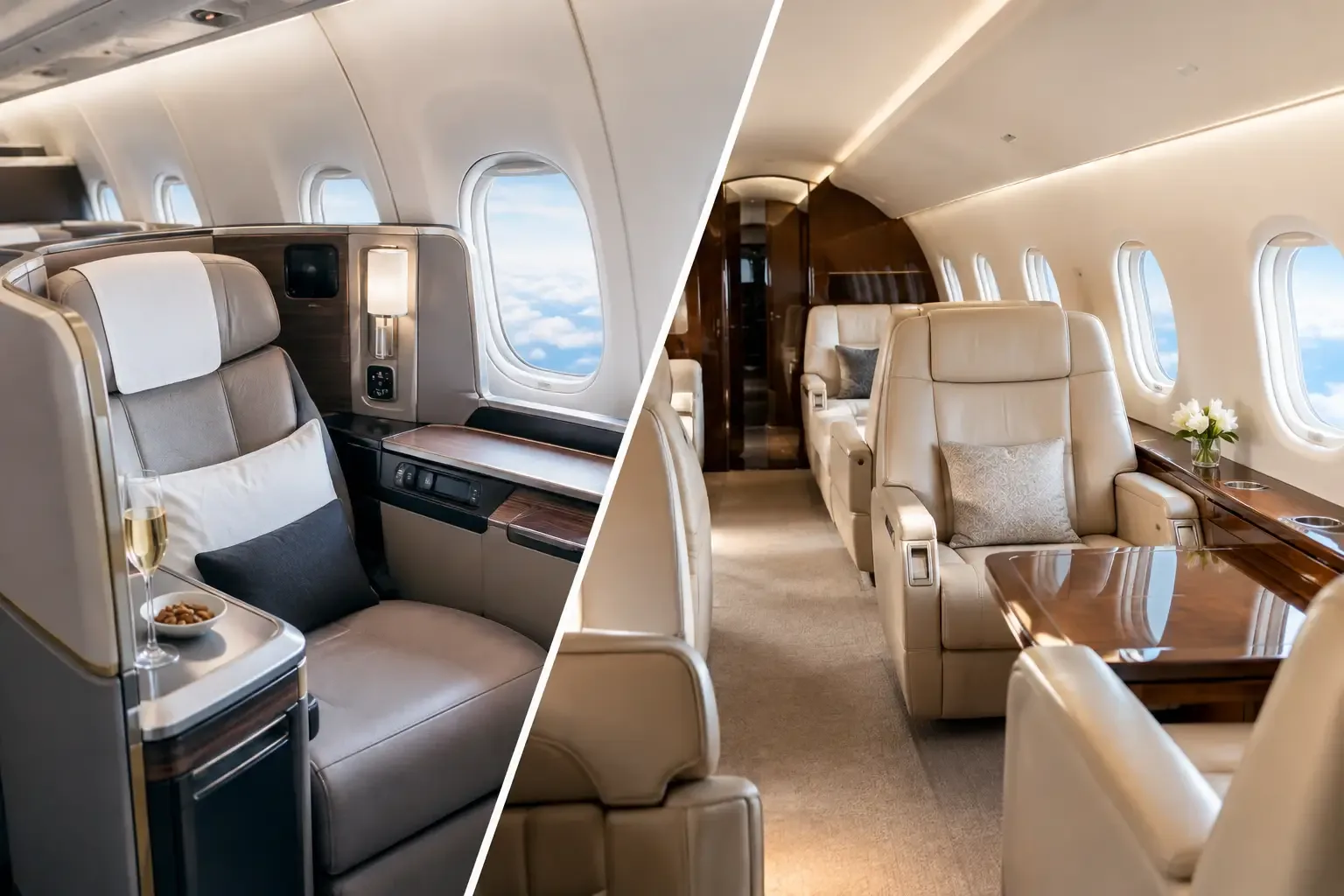
A 07:15 departure from London to New York means very different things depending on how you fly. In first class, it may mean a private terminal, an excellent suite and a quiet few hours before boarding. By private aircraft, it can mean arriving at a fixed-base operator 20 minutes before departure, bringing the meeting forward, and landing closer to where you actually need to be. The first class versus private jet decision is not really about whether one cabin has better champagne. It is about control over the day.
For a principal travelling alone on a well-served route, first class can be the sensible choice. For a family, a board delegation, a traveller carrying sensitive material, or a schedule that cannot bend around an airline timetable, charter changes the equation. The right answer depends on the mission, not the label.
First class versus private jet: the real difference
First class is a premium product within a fixed airline operation. You select from published flights, use a major commercial airport, and share the wider journey with hundreds of other passengers, even if your own cabin experience is highly private. On the best carriers, the ground service, food, bedding and inflight attention are exceptional. For an overnight long-haul flight, that can be more than enough.
Private aviation is an on-demand transport solution. The aircraft, departure time, airport pair, catering, ground transfers and passenger manifest are arranged around the brief. You are not purchasing a seat. You are commissioning an aircraft and the operational capability around it.
That distinction matters most on a day with multiple moving parts. A private jet can depart from Farnborough, Biggin Hill, London Oxford or another appropriate airport rather than being tied to Heathrow or Gatwick. It can fly to an airport commercial airlines do not serve, and wait if a meeting finishes late, subject to crew duty limits and airport operating hours. That flexibility is often the asset clients are actually buying.
When first class is the better decision
Commercial first class is difficult to beat when the route is direct, the timetable works, and the passenger count is low. A scheduled flight from London to Dubai, New York, Singapore or Los Angeles may offer a refined experience for a fraction of the cost of chartering an ultra-long-range aircraft.
It is also a strong option when you want to travel anonymously within a normal business routine. You can use private check-in, lounges and, on certain routes, dedicated first-class facilities, without arranging a full flight operation. For one person travelling to a single meeting and returning on a predictable schedule, the commercial network has reach and frequency private charter does not always need to replicate.
There is a practical aircraft consideration, too. A commercial long-haul first-class suite is designed for proper rest. On a daytime transatlantic sector, a large-cabin private jet may offer a far more productive setting. On an overnight flight, however, a first-class bed on a direct service can be the more efficient choice if you are happy to arrive on the airline’s schedule.
First class does come with hard limits. The flight will leave at its scheduled time. Airport arrival requirements still apply. Luggage, security, boarding gates, onward connections and disruption remain part of the airline system. Even with priority handling, you are operating within someone else’s timetable.
What a private jet changes
The most valuable private-jet advantage is not the cabin alone. It is the reduction of non-productive time. Arriving at a private terminal shortly before departure, avoiding a hub connection, landing nearer to the final destination and departing once the meeting is complete can return hours to a working day.
For European travel, this can be decisive. A journey such as London to Geneva, Nice, Ibiza, Milan, Paris or Zurich is often less about airborne time than the time lost either side of it. Private aviation lets the itinerary follow the meeting, the yacht, the ski transfer or the family’s plans. It can also make less obvious airport pairs viable, including regional airports closer to an estate, factory, resort or private residence.
Privacy is another consideration, but it should be understood correctly. Charter offers a controlled passenger environment, confidential manifests and the ability to hold sensitive discussions in the cabin. It does not remove every airport or border requirement, and passenger data is still handled through the proper operational channels. What it does provide is discretion with fewer public touchpoints.
The cabin can be selected for the task. A light jet may suit two to six passengers on a short European sector. A super-midsize aircraft provides more stand-up space, range and baggage capability for longer routes. A heavy or ultra-long-range jet is appropriate for transatlantic travel, Middle East missions or itineraries requiring a lie-flat sleeping arrangement, multiple cabin zones and space for staff or security. For larger groups, VIP airliners can be configured for delegations, touring teams or family travel.
This is why asking only for a “private jet” is rarely enough. Passenger numbers, baggage, pets, preferred airport, required arrival time, crew rest, runway length and whether the aircraft must wait all affect the right aircraft and the final cost.
Cost: compare the whole journey, not the ticket
First class is priced per passenger. Private charter is priced per aircraft, with variables including sector length, aircraft category, airport charges, positioning, crew overnight costs, de-icing, permits and the shape of the wider itinerary. A one-way flight can sometimes involve an empty repositioning sector before or after your journey. A return with the aircraft waiting may be better value than two separate one-way charters, but not always.
For one or two people flying direct long-haul, first class will usually be materially less expensive. For six to 10 passengers travelling together, especially on a short-notice European itinerary, the cost gap can narrow when assessed per person. That does not make charter inexpensive. It makes it a commercial decision based on time, privacy and control rather than a simple comparison of fare classes.
The calculation should also include the value of the day. If a six-person executive team avoids a connection, completes a meeting, and returns home that evening, the aircraft may protect more than convenience. Equally, if the team is travelling to a major city on a reliable direct service with no schedule pressure, first class or business class may be the more disciplined decision.
The details that decide the right option
The strongest travel planning starts with the result required, not the aircraft category. Do you need to be in Cannes by 10:00, leave immediately after lunch and arrive in London before the evening? Are two children, a nanny, a dog and ski equipment travelling together? Is the journey a board meeting requiring secure conversation, or a solo overnight flight where rest is the priority?
A good aviation adviser will ask for the non-negotiables: exact passenger count, names when ready, baggage profile, preferred departure and arrival airports, timing tolerance, catering requirements, ground transport and any security or accessibility needs. From there, the options become clear. Sometimes the answer is a commercial first-class booking supported by chauffeur transfers and airport assistance. Sometimes it is a midsize jet. Sometimes a commercial flight out and a private return is the sensible hybrid.
Use the aircraft where it earns its place
Private aviation earns its place when it solves a genuine operational problem: inconvenient airport access, compressed schedules, a group travelling together, sensitive business, substantial luggage, a family itinerary or a route with limited commercial service. First class earns its place when the network already does the job well and the fixed schedule does not cost you control.
At The 0.1% Group, the brief is assessed independently rather than pushed towards a captive fleet. That allows the recommendation to follow the route, the timing and the people travelling, whether the right answer is a light jet from London to the South of France or a first-class seat on a direct long-haul service.
Give your travel plan the same scrutiny you would give any other high-value decision. State the non-negotiable outcome first, then choose the form of travel that protects it.