




A discontinued Rolex is rarely difficult to find in the abstract. The challenge is to source discontinued Rolex watches at the right standard: the correct reference, credible provenance, honest condition, sensible market positioning and a transaction handled without unnecessary exposure. Those details determine whether a watch becomes a long-term part of a collection or an expensive compromise.
For collectors and principals who know what they want, a retail waiting list is irrelevant. The work begins in the secondary market, where availability changes daily and the difference between two apparently identical pieces can be substantial.
Why discontinued Rolex references require a different approach
Discontinuation changes a watch's market. There is no longer a straightforward route through an authorised retailer, no predictable delivery window and no replacement stock once a particular dial, bezel, bracelet or production configuration disappears. Supply is fixed, while demand can rise quickly when collectors recognise that a reference has left the catalogue.
That does not mean every discontinued Rolex is automatically a strong acquisition. Some references become desirable because they marked the end of a particular design era. Others appeal because of low production, a short dial run, an unusual regional configuration or a specification that Rolex later changed. The right choice depends on whether the priority is wearability, collection depth, rarity, investment discipline or a specific personal connection to the model.
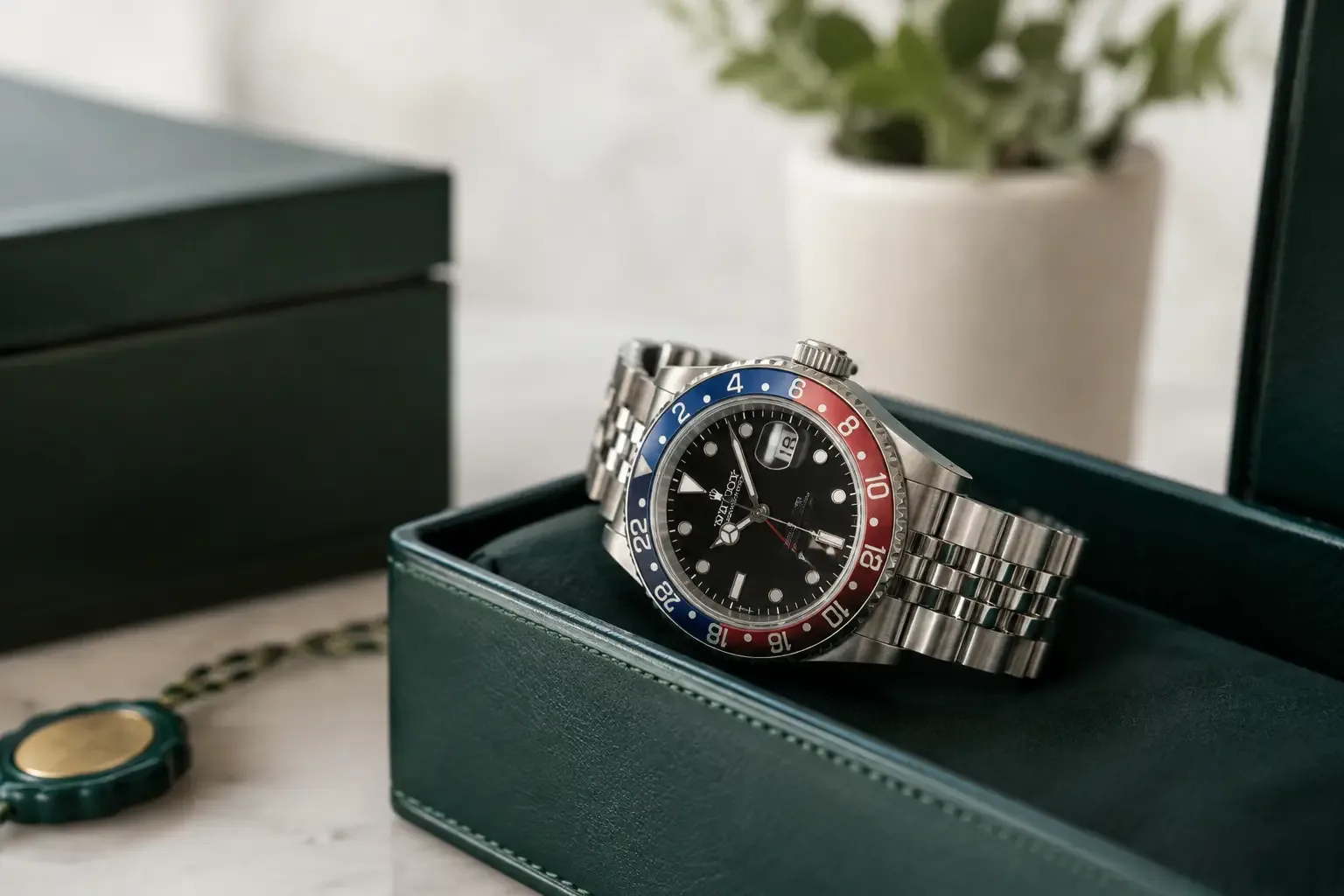
A discontinued ceramic Daytona, a five-digit GMT-Master II, a green Submariner, an early Yacht-Master or an older Day-Date may all sit under the broad label of collector Rolex. They should not be bought using the same criteria. A sports reference with full original accessories has a different market dynamic from a precious-metal dress watch whose value sits primarily in condition, dial originality and service history.
Start with a precise brief, not a model name
"A discontinued Rolex" is not enough information for a serious search. It creates avoidable back-and-forth and can lead to offers that look attractive but do not meet the actual requirement. A clear brief lets a specialist move quickly through private collectors, established dealers and trusted international stockholders.
At minimum, define the reference number if known, preferred dial and bezel configuration, metal, bracelet, acceptable production period and budget range. It is also useful to state whether a full set is mandatory, whether polished examples are acceptable and whether the watch is intended for frequent wear or as a collector-grade acquisition.
Full set versus watch-only
A full set generally means the watch, original box, warranty card or papers, booklets, tags and relevant accessories. It usually commands a premium, particularly for discontinued sports models. For a collector seeking completeness, that premium can be entirely justified.
For a client who intends to wear the watch regularly, a watch-only example from a credible source can represent better value. The key is not to treat paperwork as a substitute for due diligence. Papers can support a watch's story, but they do not by themselves prove originality, condition or legitimacy.
Originality versus perfection
An untouched-looking watch is not always the better watch, and a freshly refinished example is not always a problem. The issue is transparency. Rolex cases and bracelets can be professionally restored, but excessive polishing can soften case lines, reduce the definition of lugs and alter the character that collectors value.
Dials, hands, bezels and bracelets deserve the same attention. A period-correct service part may be practical for a watch intended to be worn. It may be less desirable on a rare reference where original components are central to value. The brief should make that distinction clear from the outset.
How we source discontinued Rolex watches
The most efficient route is a managed search rather than browsing public listings until something appears. Public marketplaces can be useful for observing price direction, but they do not provide the whole market, and the best pieces are often offered privately before they are advertised widely.
A specialist begins by confirming the exact target and establishing what can be compromised. Perhaps the client will accept a 2018 example rather than 2019, but not a replacement dial. Perhaps box and papers are preferred but condition is non-negotiable. Those decisions shape the search and prevent good options being missed over details that do not matter.
The search then moves through an established global network. Each prospective watch should be reviewed beyond its headline photographs. This includes reference and serial consistency, dial and handset correctness, case condition, bracelet stretch where relevant, clasp codes, accessories, service records and seller history. For higher-value or particularly rare pieces, an independent inspection or authentication step should be considered before funds are released.
Availability can be immediate, but the right piece may take longer. A credible adviser gives real timelines from real requests, rather than promising a particular watch simply to win the instruction. If a target is scarce, the sensible choice may be to wait for a better example rather than force a purchase at the first available price.
Read condition as part of the price
Two examples of the same reference can differ materially in value even when their photographs look similar. This is where apparent bargains become costly. A lower entry price may reflect a heavily polished case, an incorrect bezel insert, replaced hands, missing links, limited provenance or an undisclosed history of damage.
Condition should be evaluated in context. A daily-wear Rolex that has been responsibly serviced and lightly refinished may be an excellent choice. A collector-grade piece should retain the details that define its era, with a condition report that matches the asking price. Neither is universally better. The mistake is paying collector-grade money for an ordinary example.
Service history also needs perspective. Rolex service can improve reliability, water resistance and usability, but it can involve the replacement of original components. If period originality matters, agree in advance that any removed parts should be retained where possible and that no cosmetic replacements are authorised without approval.
Provenance, authentication and the practical checks
Discretion does not mean skipping process. It means the process is controlled, documented and handled in confidence. Before completing a purchase, the basics should be clear: who is supplying the watch, where it is held, whether it is available for inspection, what is included and how the condition has been assessed.
For a significant purchase, request detailed, current images and video rather than relying on catalogue photography. Examine the reference, serial where appropriate, movement condition, bracelet and clasp, and any supporting documents. A reputable source should be comfortable addressing these points directly.
Four checks are particularly useful when comparing opportunities:
- The watch should match the stated reference in its case, dial, bezel, bracelet and configuration.
- The condition report should identify polishing, replaced components, service work and any material imperfections.
- The accessories should be consistent with the watch's production period and seller description.
- The commercial terms should state inspection, delivery, insurance and payment arrangements before funds move.
Authentication is not a single event. It is a chain of confidence built from the supplier, the watch itself, the paperwork, the inspection process and the transaction record. The more unusual or valuable the reference, the more that chain matters.
Price discipline matters more than market noise
Discontinued Rolex prices can move sharply around catalogue changes, auction results, celebrity exposure and shifts in wider luxury demand. Short-term noise is not always a reason to act. The better question is whether the offered watch is correctly priced for its exact specification and condition.
A disciplined buyer compares like with like. A full-set, unpolished example with strong provenance should not be benchmarked against a watch-only piece with unclear service history. Equally, a premium should have a clear rationale. Rarity claims need evidence, not sales language.
For clients purchasing internationally, the delivered price also matters. Consider secure transport, insurance, duties where applicable, payment timing and the location of the watch. A cheaper overseas offer can stop being cheaper once logistics and risk are accounted for.
A single point of contact changes the experience
Sourcing a discontinued Rolex should not require a client to manage multiple dealers, arrange authentication, chase images, negotiate delivery and reconcile payment logistics alone. The 0.1% Group manages the brief through one dedicated contact, from market search and verification through to secure delivery, with cryptocurrency and stablecoin settlement available where appropriate.
The best time to start is before the purchase becomes urgent. Give a precise brief, decide what cannot be compromised and leave room for a genuinely superior example to surface. When it does, the difference between missing it and securing it is usually not interest. It is having the right process already in place.