




A Richard Mille watch provenance check should begin before price, payment terms or delivery are discussed. At this level, provenance is not a nice extra for a future buyer. It is the evidence that supports the watch’s legitimacy, condition, marketability and value - particularly where rare references, limited editions and secondary-market allocations are concerned.
Richard Mille is a category where details carry weight. A correct-looking watch with incomplete paperwork, an unclear seller history or mismatched service information can become difficult to insure, resell or place with a serious collector. The objective is straightforward: establish exactly what the watch is, where it has been, who is entitled to sell it and whether the supporting record stands up to scrutiny.
Why provenance matters with Richard Mille
Richard Mille watches are highly technical, low-volume and frequently traded at values far above retail. That combination attracts informed collectors, speculative demand and, inevitably, sophisticated counterfeit activity. A provenance file does not replace physical authentication, but it gives the inspection a credible commercial context.
For a collector, clean provenance can protect liquidity. For a family office or adviser acquiring on behalf of a principal, it provides an auditable decision trail. For an owner considering a future sale, it can be the difference between a straightforward transaction and a long sequence of questions from prospective buyers.
It also matters because not every legitimate Richard Mille will arrive with a complete first-owner archive. Watches change hands privately. Original purchasers relocate. Documents are lost. A missing invoice is not an automatic reason to walk away, but it changes the level of verification required and should be reflected in the price and transaction structure.
What a Richard Mille watch provenance check should establish
A proper check is a chain of evidence, not a glance at a warranty card. Start by identifying the exact reference, material, edition details and stated production configuration. The watch itself, its identifying numbers and its documentation must tell the same story.
Documentation and identifiers
The strongest file typically includes the original warranty documentation, any certificate supplied with the model, service records and, where available, the original sales invoice. Presentation items such as the box, booklets and accessories can support completeness, but they are not proof of authenticity on their own.
Documentation should be examined for consistency rather than simply presence. Dates, retailer details, reference information and owner entries should make commercial sense. Signs of alteration, reprinting or unexplained discrepancies need answers. A warranty document that appears correct but does not align with the watch’s identifiers is a material issue, not a minor administrative point.
Do not circulate full serial or identification details casually over unsecured messaging. A credible buyer needs enough information to verify the watch, while sensitive data should be handled on a need-to-know basis and retained securely.
Ownership history and seller authority
The seller should be able to explain how the watch was acquired and why it is being sold. That explanation need not be theatrical. In fact, a clear, consistent account supported by appropriate paperwork is usually more convincing than an over-produced narrative.
Where the seller is not the named purchaser, establish the transfer path. This may involve a private sale record, a dealer invoice, estate documentation or correspondence that supports a legitimate change of ownership. Personal details can be redacted where confidentiality is required, provided the key facts remain verifiable.
If a company, trust or representative is selling, confirm that the individual instructing the sale has authority to do so. For high-value transactions, this is as important as confirming the watch itself. A genuine watch offered by somebody without the right to sell it is not a risk worth taking.
Service history and condition
Richard Mille service records can be particularly useful because they help establish continuity between the physical watch and its documented life. They may also reveal substantial repairs, replacements or changes to components. This is not automatically negative - properly serviced watches are expected - but it affects how the piece should be described and valued.
Ask direct questions. Has the case been refinished? Have dial, hands, strap, clasp or movement components been replaced? Has the watch suffered impact damage or water ingress? Is any service currently due? A watch that looks immaculate may have been restored extensively, and an untouched example may carry honest wear. Neither position is inherently better. What matters is accurate disclosure and pricing that reflects it.
Stolen-property and compliance checks
A provenance review should include appropriate stolen-property screening and checks against available market intelligence. This is especially relevant where the offered price is unusually favourable, the seller insists on urgency or the ownership route is vague.
Payment also deserves care. Whether settlement is by bank transfer, cryptocurrency or another approved method, the transaction should have a clear paper trail. The parties, source of funds and receiving details should be understood before funds move. Privacy is expected in this market; avoidable opacity is not.
Authentication and provenance are different disciplines
A Richard Mille can be physically authentic and still have weak provenance. Equally, a complete set of documents cannot make an inauthentic or materially altered watch acceptable. The two checks must run together.
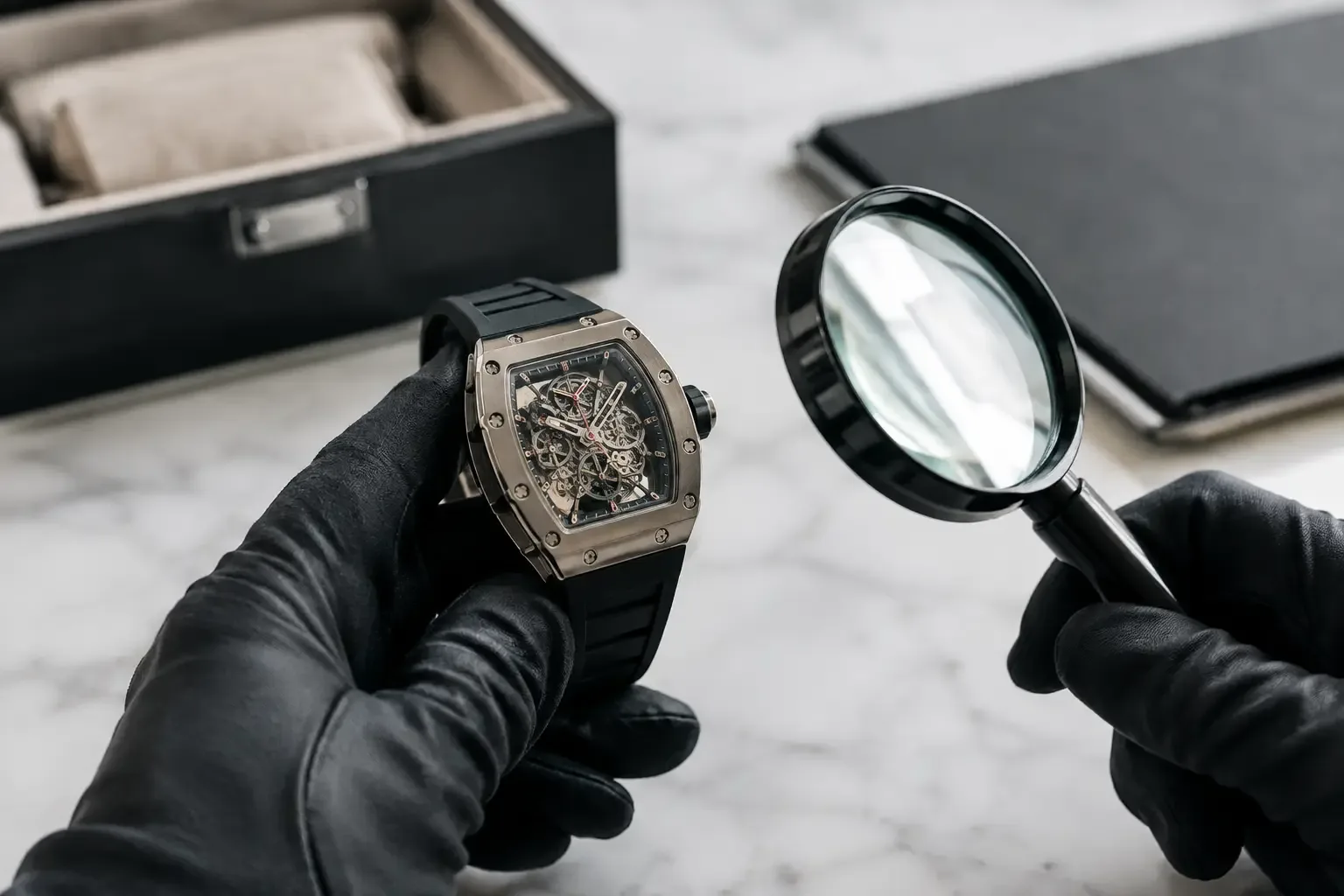
Physical authentication should be undertaken by a suitably qualified specialist with experience of the relevant Richard Mille reference. This involves more than comparing photographs. It may include close examination of case construction, dial execution, movement architecture, components, weight, finishing and the relationship between the watch and its supplied documentation.
The trade-off is time and access. A seller may be reluctant to release a rare watch for inspection before receiving commitment from a buyer. In that situation, use a controlled process: agree the price subject to verification, use an appropriate holding arrangement for funds where necessary, and make final completion conditional on the inspection outcome. No serious seller should object to sensible protection on a transaction of this scale.
Warning signs that deserve a pause
One missing item is not always a problem. Several small inconsistencies often are. Be cautious if the seller will only provide heavily edited images, refuses an in-person or independent inspection, changes the ownership account, or presses for immediate payment before basic checks are complete.
Other concerns include documentation that appears newer than it should, service papers that do not correspond to the watch, an offer materially below prevailing market levels, or a request to settle to an unrelated third party. None proves wrongdoing in isolation. Together, they justify stepping back until the facts are resolved.
A good acquisition process does not accuse the seller. It simply sets a standard: verify first, transact second.
How to buy with control
For an important Richard Mille acquisition, appoint one party to manage the process from sourcing through delivery. That party should obtain the watch’s available history, coordinate authentication, assess condition, agree written terms and keep a clear record of the handover and payment.
This approach is particularly valuable when the watch is being acquired while travelling, delivered internationally or settled in crypto. The watch, the funds, the insurer, the courier and the seller should all move to the same timeline. Fragmented arrangements create gaps, and gaps are where expensive errors occur.
The 0.1% Group can source rare Richard Mille references through its specialist network and handle the acquisition with a single accountable point of contact, including discreet verification, secure delivery and crypto-enabled settlement where appropriate.
The right watch is not simply the one that can be located first. It is the one whose story can be tested, whose condition is understood and whose ownership can be transferred without unanswered questions.