





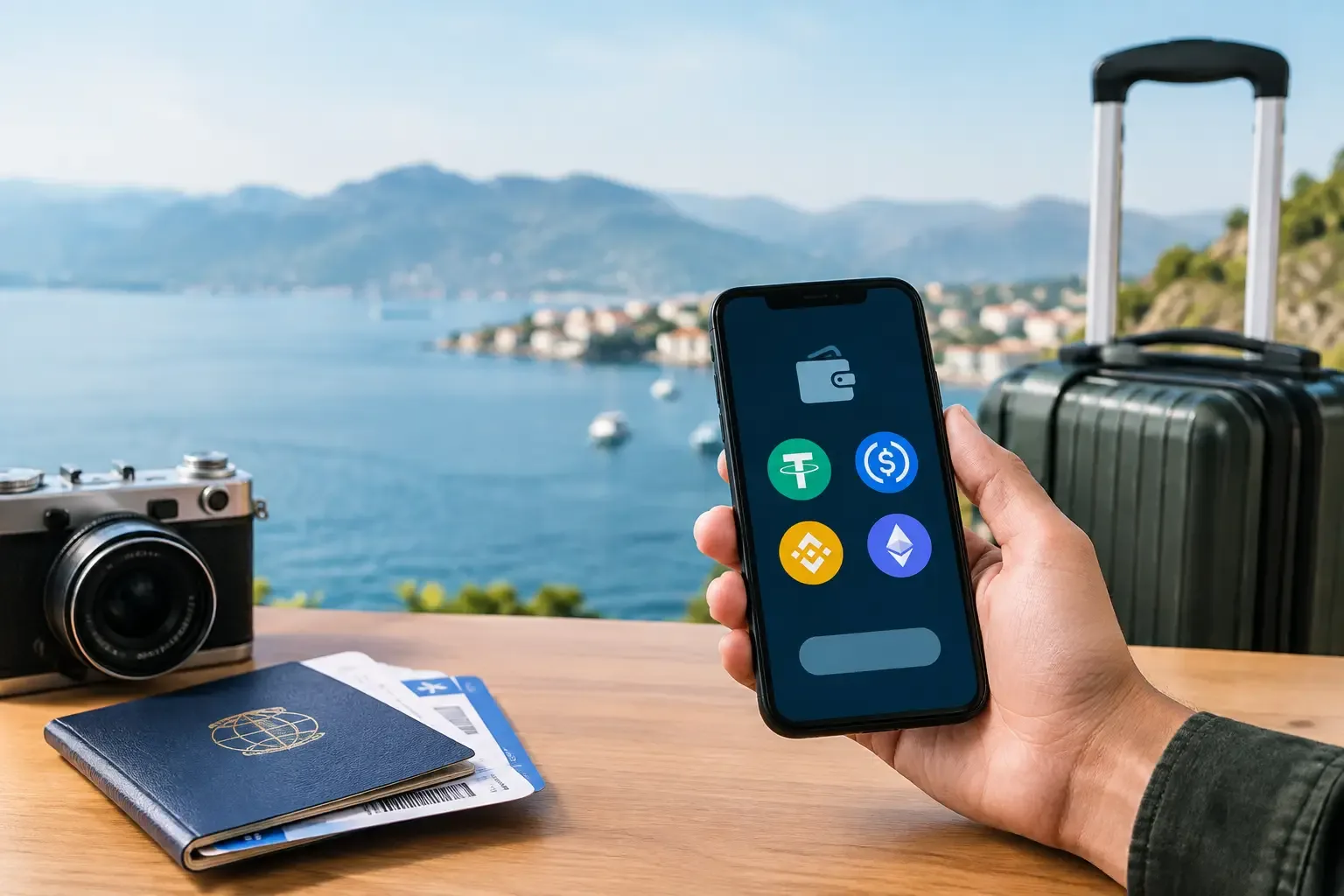
A departure slot is held. The aircraft is positioned. Your hotel, transfers and onward arrangements are being confirmed. At that point, payment should not become the slowest part of the itinerary. Clients who pay travel with stablecoins can settle substantial travel costs quickly, provided the payment process is structured correctly from the outset.
For private aviation, villa bookings and multi-country travel, stablecoins offer a practical alternative to conventional bank transfers, particularly outside banking hours or where several currencies and jurisdictions are involved. They are not a substitute for due diligence, clear commercial terms or travel planning. Used well, they remove friction at the point it matters most: confirming a time-sensitive arrangement.
Why stablecoins suit high-value travel
A stablecoin is designed to track the value of a conventional currency, most commonly the US dollar. In travel, that stability is the point. A charter quote may be denominated in GBP, EUR or USD, but payment can be made in an agreed stablecoin amount without exposing the transaction to the price movements associated with more volatile digital assets.
The operational benefit is speed. A traditional international transfer can be delayed by cut-off times, intermediary banks, compliance reviews or a weekend. Stablecoin settlement can be visible within minutes once the transaction has been sent and confirmed on the correct network. That can make the difference between securing the preferred aircraft and accepting what remains available.
There is also a practical benefit for globally mobile principals. Rather than moving funds between multiple accounts before a trip, an approved wallet can be used to settle a defined invoice directly. The transaction still requires verification, but it can reduce unnecessary steps where time is limited.
Discretion is often misunderstood here. Blockchain transactions are traceable, not anonymous. Properly handled stablecoin payments offer privacy through controlled communication, limited distribution of sensitive information and a clear payment workflow, not through avoiding checks. Reputable providers will know who they are contracting with and where funds originate.
How to pay travel with stablecoins without delays
The best payment process starts before an itinerary is finalised. State that you intend to pay in stablecoins when you make the request. Your concierge can then confirm whether the supplier accepts direct settlement or whether payment will be processed through an approved payment partner.
The quote should specify the travel service, cancellation terms, currency basis, the accepted stablecoin, the blockchain network, wallet address and the point at which the rate is fixed. These details matter. Sending USDT when USDC was requested, or using an unsupported network, can create a preventable delay at precisely the wrong moment.
Once the commercial terms are agreed, the provider will normally complete proportionate client and source-of-funds checks. For a private jet charter or a high-value itinerary, expect to provide identity and entity documentation where relevant. If payment is made by a company, family office or trust, authority to instruct and beneficial ownership may also need to be established. This is standard protection for both sides, not an administrative obstacle to work around.
After approval, receive payment instructions through a verified channel. Do not rely on a wallet address copied from an unverified message or forwarded by a third party. For a first transaction, it can be sensible to send a small test amount if timing permits. For urgent departures, the more effective solution is to verify instructions verbally with your dedicated contact before sending the full amount.
The payment is then monitored for network confirmation and reconciled against the invoice. Only once confirmation is received should you treat the aircraft, villa or other service as paid and fully released. A transaction may appear in a wallet immediately while still awaiting the required confirmations.
The details that determine whether payment is straightforward
Stablecoins are not interchangeable simply because they are all dollar-pegged. USDC and USDT are widely recognised, but their acceptance varies by provider, jurisdiction and blockchain. The network matters just as much as the token. Ethereum, Tron, Solana and other networks each have different transaction speeds, costs and address formats.
For a high-value payment, agree the network before the invoice is issued. A lower network fee is irrelevant if the receiving party cannot process the transfer. It is equally sensible to clarify who bears any conversion, processing or network costs, especially where the underlying travel quote is in sterling or euros.
Timing deserves the same attention as route planning. Aircraft operators may require cleared funds before releasing an aircraft, while a villa owner may require a deposit first and a balance closer to arrival. If an itinerary spans several suppliers, do not assume every element can be settled using the same method or on the same timetable. A capable concierge will map this before asking you to send funds.
Cancellation and refund mechanics should also be explicit. If a flight is cancelled because of weather, operational disruption or a change in your plans, the contract should state whether funds are returned in the original stablecoin, converted into the invoicing currency or held as credit. The same applies to any exchange-rate difference where a stablecoin is converted before settlement with a supplier.
Where stablecoin travel payments work best
Stablecoins are particularly useful when the request is urgent, international or operationally complex. A last-minute private jet from London to the Middle East, a multi-leg European itinerary with different departure points, or a villa booking requiring immediate confirmation can all involve payment deadlines that do not align with conventional banking hours.
They can also simplify travel arranged around a wider brief. You may be chartering an aircraft, securing a waterfront villa, arranging chauffeurs and confirming restaurant access for a group. The value is not merely paying digitally. It is having one accountable contact coordinate the payment requirements, supplier deadlines and confirmation trail across the itinerary.
That said, stablecoins are not always the best answer. Some suppliers will only accept bank transfer or card payment. Others may accept digital assets through an intermediary, which adds a processing step and potentially a fee. For a routine booking with ample lead time, a standard transfer may be entirely appropriate. The right method depends on availability, jurisdiction, contract terms and how quickly the service must be secured.
A practical checklist before you send funds
Before authorising payment, confirm the agreed stablecoin and network, verify the wallet address through a trusted channel, and make sure the invoice names the contracting entity. Check whether the price is fixed in the quoted currency or fixed in tokens at a stated time. Confirm the number of blockchain confirmations required and ask for written acknowledgement once funds have cleared.
Keep a complete record of the invoice, payment instructions, transaction hash, correspondence and confirmation of service. This is useful for internal reporting, travel records and any later change to the itinerary. If an assistant, finance lead or family office is sending the payment on your behalf, make the approval chain clear before an urgent request appears.
Travel payments should match the pace of the trip
The 0.1% Group handles crypto-enabled travel arrangements with the same discipline as aircraft sourcing: the brief is confirmed, availability is secured, payment instructions are verified and every moving part is managed in confidence. No generic checkout flow, no unnecessary handovers.
A stablecoin payment should give you control, not create another task to supervise. Give your travel adviser the payment preference early, keep the documentation ready, and insist on verified instructions before funds leave your wallet. Then the financial side of the journey can move at the pace your itinerary requires.