




There are two ways to buy a Pokémon card with crypto. You can buy from a seller that takes crypto, from whatever that seller has. Or you can have the card you want found for you and settle in crypto once it is agreed. We do the second. The 0.1% Group sources graded and high-value cards on request and accepts Bitcoin, Ethereum, USDT, USDC and other major coins. We hold no stock. This guide covers where crypto works, what the grade on a slab tells you, how to spot a fake, and how settlement goes.
Can you buy Pokémon cards with crypto?
Yes, though most of the card market still runs on card payments and bank transfers. Crypto works in four places.
- Dealers with a crypto checkout. Some specialist card shops take Bitcoin or stablecoins through a payment processor. You buy from their stock at their price, and the processor handles the coin.
- Vaulted, tokenised cards. Some platforms keep graded cards in a vault and record ownership as a token on a blockchain. You buy and sell the token, often in a stablecoin, and can ask for the physical card to be shipped. Read the redemption terms, the fees and who insures the vault first. The token is only as good as the vault behind it.
- Private sales. The rarest cards often change hands between collectors. A seller may take crypto directly, or prefer an intermediary who pays them in their own currency. This is where the checks below matter most.
- A sourcing service. You give the brief. We find the card through dealers, auction houses and private collectors, set out the individual card in writing, and you settle in crypto. If the seller wants to be paid in pounds, dollars or euros, that is our side of the arrangement, not yours.
Name the card, then the grade
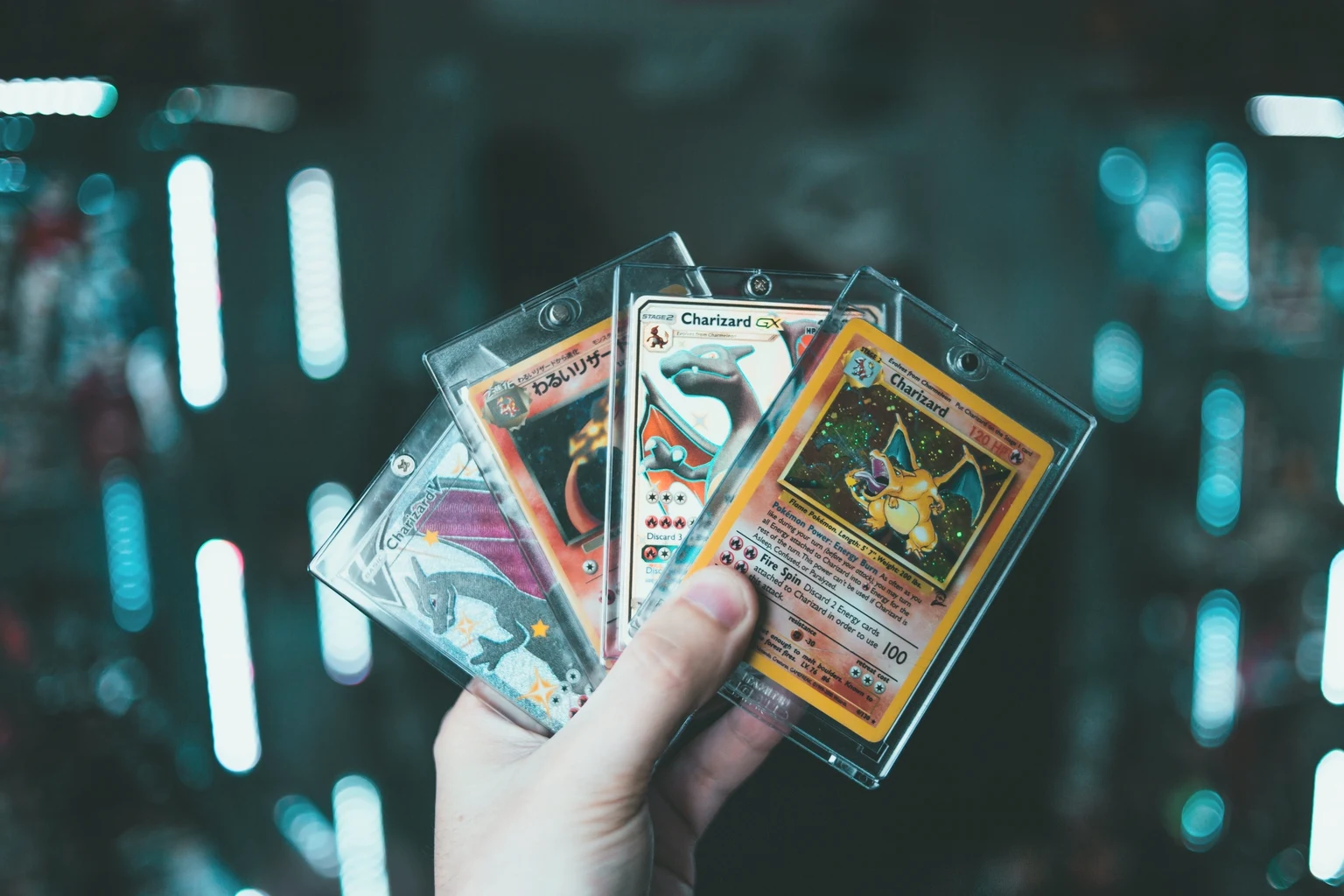
“A Charizard” tells us very little. The Base Set holo Charizard alone was printed as 1st Edition, Shadowless and Unlimited, then reprinted in Base Set 2 and later sets. Japanese and English cards are different items with different markets. A promo or a trophy card is a separate search again.
A useful brief has:
- the card name and set, with the card number if you have it
- the edition or printing, and the language
- the grading company and the lowest grade you would accept
- whether a raw, ungraded card is acceptable
- your budget, your timing and where the card should go
If you know the card you saw but not its set, describe it or send a photograph. We narrow it with you before we go to the market.
PSA, BGS and CGC: what the grade tells you
Three grading companies account for most of the high end: PSA, Beckett, whose grades are known as BGS, and CGC. Each seals the card in a tamper-evident plastic case, the slab, with a label carrying the grade and a certification number.
- PSA grades on a scale of 1 to 10. A PSA 10 is Gem Mint, and for many cards it sells at a large premium over a PSA 9.
- BGS prints four subgrades on the label, for centering, corners, edges and surface, next to the overall grade. A 10 on all four earns the Black Label, which few cards achieve.
- CGC uses a 10-point scale with two top grades. Pristine 10 is the highest; Gem Mint 10 is a 10 that falls short of Pristine on one criterion.
The grades do not convert one for one. The market prices a PSA 10, a BGS 9.5 and a CGC 10 of the same card differently, and the gap changes from card to card. Tell us which slabs you would accept and we search for those.
Fakes, and fake slabs
Counterfeit Pokémon cards are common at the cheap end of the market. At the expensive end the risk moves to the slab: a relabelled case, a reopened one, or a printed label that copies a real certification number. PSA itself warns that counterfeiters take genuine cert numbers from public sources, so a number that checks out online does not prove the slab in front of you is the one it was issued for.
Four checks help.
- Look the number up yourself. Type the certification number into the grader’s own website. Do not follow a link or QR code supplied by the seller. Confirm the card, set, language and grade match.
- Compare the images. PSA and CGC show scans of many of the cards they have certified. Hold the database image against the card on offer. Centering, print lines and small marks should agree.
- Look at the slab. Check the label print, the hologram and the seams for any sign that the case has been opened.
- Treat raw cards with care. An ungraded card carries no third-party opinion. If it is expensive, buy it graded, or allow the time and cost of submitting it before the price makes sense.
A blockchain transfer does not help with any of this. The transaction hash proves you paid. It says nothing about the card.
Escrow and settlement
A crypto payment cannot be charged back. Once it is sent, it is gone. So the order of events matters more than it would with a credit card. The card is identified and checked before any money moves, and you should know who holds the funds until the card has arrived and been inspected.
On a marketplace, that is the platform’s escrow and its terms. In a private sale, it is a trusted intermediary or a payment staged against delivery. With us, the price is agreed for the individual card first. The payment instructions then state the asset, the network, the crypto amount, the exchange-rate basis and how long the quote is valid. How settlement is staged around inspection and delivery is set out in writing for that purchase, before you send anything.
Check the recipient address and network through the contact channel you already have with us. A message from a new number or a changed address is a reason to stop and call.
Stablecoins or Bitcoin?
For a card priced in dollars or pounds, a stablecoin is usually the cleaner way to pay. USDT and USDC are designed to track the US dollar, so the amount you agree is close to the amount that arrives. Both run on several blockchains. Send on the network named in the instructions, and keep a little of that network’s own coin in the wallet to pay the transfer fee. The USDT guide covers networks, gas and the quote window in more detail; it is written for watches, but the payment steps are the same.
Bitcoin works too, with one difference. Its price moves, so a Bitcoin quote holds for a short window. New blocks arrive about every ten minutes, and a recipient usually waits for a few of them before treating a payment as received, so send well inside the window. Ethereum is the same in principle: the amount is fixed for a limited time, and the transfer fee is paid in ETH.
Tax and records
This is general information, not advice. Spending cryptocurrency can count as a disposal for tax purposes in the UK, as HMRC’s Cryptoassets Manual explains, and in many other countries. Buying a card with Bitcoin can therefore mean a gain or a loss on the Bitcoin. Selling the card later may be taxed as well, under rules that depend on where you live. Import duty and VAT can apply when a card crosses a border.
Whatever your position, keep the records together:
- the invoice for the card, with its grader, grade and certification number
- the date, the coin, the amount and the exchange rate used
- the transaction hash and the sending and receiving addresses
- delivery and any customs paperwork
Then take them to your adviser.
How we source a card for you
- Brief. Send the card by WhatsApp or the enquiry form, with the grade you would accept and the coin you would like to settle in.
- Source. We go to dealers, auction houses and private collectors and come back with what is realistic on availability, price and timing. Rare cards can take time, and we say so at the start.
- Verify. The proposed card is set out in writing: card, set, edition, language, grader, grade, certification number and images. You check the number on the grader’s site yourself before you decide.
- Settle and deliver. The price is agreed for that card. Payment instructions follow, and delivery is fully insured and signed for, or the card is collected in London.
Cards are often one part of a wider request. If you are also arranging a watch, a flight or something harder to describe, the crypto concierge handles them in the same conversation. For watches specifically, see buying a watch with crypto and how to buy a Rolex with crypto.
What we do not do
We do not publish prices for cards we have not found, and we do not promise timing we cannot keep. We do not tell you a card will go up in value; prices for graded Pokémon cards have moved sharply in both directions. We do not give tax or investment advice. And we do not treat a listing photograph as evidence about the card on offer.
The same approach works for other graded collectibles, such as sports cards and graded comics, which PSA and CGC also certify.