




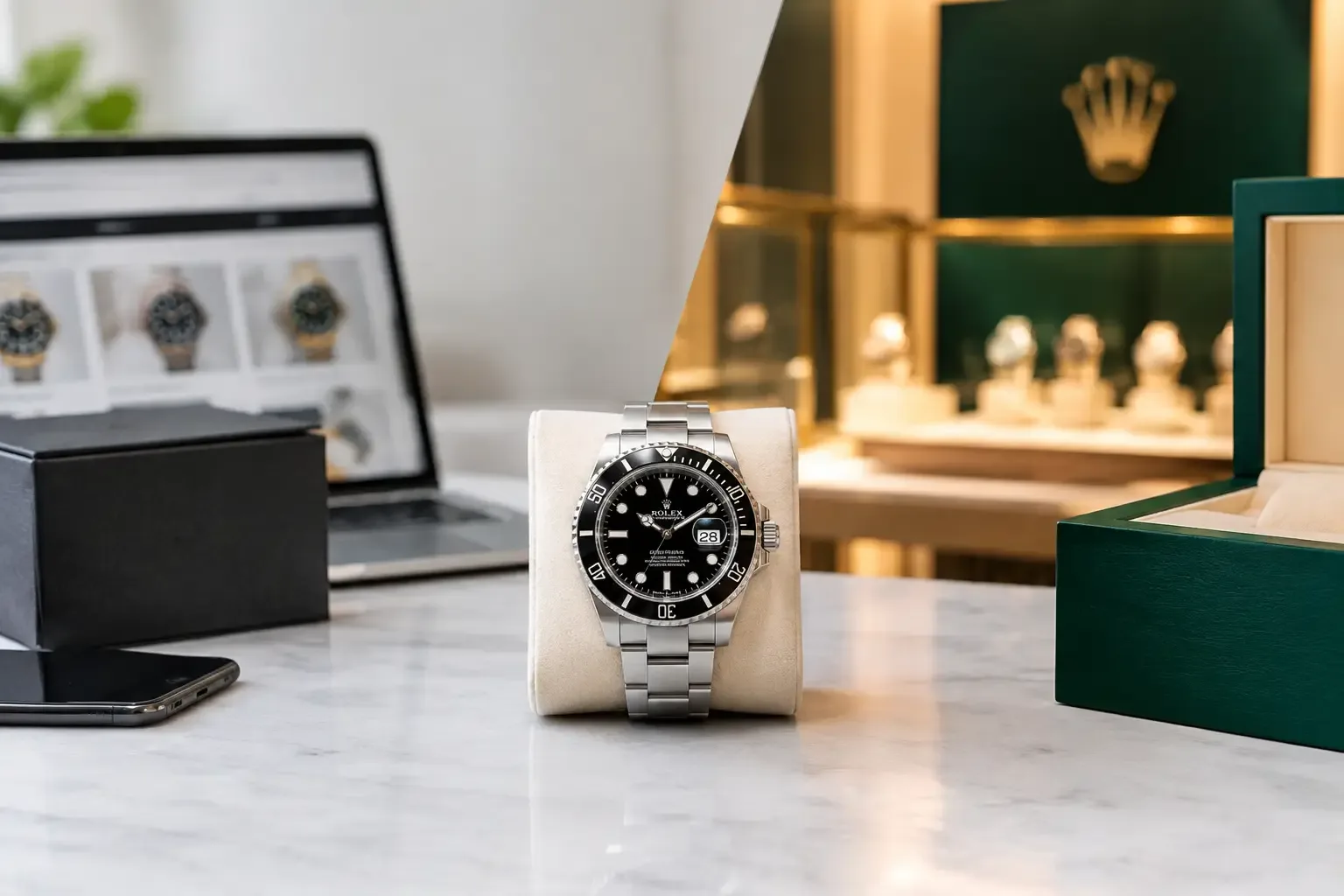
A steel Daytona at retail is not simply a purchase. For most buyers, it is an allocation decision made over time, subject to availability that can change without notice. That is why the Rolex grey market versus dealer question matters: one route prioritises official retail pricing and factory delivery; the other prioritises access, reference-specific choice and speed.
Neither is automatically better. The right answer depends on the watch, your timeframe, how much flexibility you have on configuration, and whether the saving at retail justifies an uncertain wait. For a client who wants a particular 2024 GMT-Master II before travelling to the Middle East next week, the calculation is different from that of a collector prepared to wait for a Datejust allocation from an authorised dealer.
Rolex grey market versus dealer: the practical difference
An authorised Rolex dealer sells new watches supplied by Rolex at the official UK retail price. You receive a watch in factory-new condition, with its dated Rolex guarantee card, presentation box and documentation. The five-year international Rolex guarantee begins on the date shown on the card.
The grey market, more accurately described as the secondary or independent market, consists of specialist dealers, private collectors and global sourcing networks selling watches outside Rolex's authorised retail channel. A grey-market watch may be unworn, nearly new, vintage or discontinued. It may still carry the balance of its Rolex international guarantee, or it may be sold with an independent dealer warranty if the manufacturer cover has expired.
The distinction is commercial, not necessarily a question of authenticity. A properly sourced grey-market Rolex can be entirely genuine and correctly documented. The difference is that Rolex has not supplied that watch to you directly through an authorised dealer.
The authorised dealer route
The advantage of an authorised dealer is straightforward: you pay the published retail price and receive the watch through the brand's intended channel. For references that are readily available, this is usually the most rational place to begin.
It also gives buyers confidence in the chain of custody. There is no question over where the watch originated, whether it has been altered, or whether paperwork is complete. If a new Rolex develops a manufacturing fault within the guarantee period, the official service network is the natural route for resolution.
The constraint is allocation. Demand for certain professional models, particularly steel sports references, materially exceeds supply. An authorised dealer may register your interest but cannot always provide a dependable delivery date. A strong purchase history can help, but it is not a contractual right to a sought-after watch. Policies vary between boutiques and may change according to stock, local demand and client relationship.
For buyers with no immediate deadline, establishing a relationship with an authorised dealer can be worthwhile. It is particularly sensible when you enjoy the process, intend to build a collection over years, and are open to more than one dial, bezel or bracelet configuration.
For buyers who need one precise watch, however, an open-ended expression of interest is not the same as confirmed availability.
What the grey market actually buys you
The grey market prices availability. If a watch is scarce at retail, the market premium reflects what it costs to acquire that exact reference now. For some models, the premium can be substantial. For others, particularly precious-metal, gem-set or less universally demanded references, an independent dealer may offer a price closer to retail or even below it.
Its greatest value is specificity. You can request a Rolex Daytona in a particular metal and dial, a full-set 2018 Submariner, an unworn left-handed GMT-Master II, or a discontinued reference no longer offered by Rolex. The market can then assess real stock rather than theoretical allocation.
This is also the more practical route for international clients. A specialist can identify the location of the watch, confirm the commercial terms, arrange insured delivery or a discreet handover, and clarify whether UK VAT, import duty and customs arrangements apply before funds move. That operational clarity matters more than a headline price.
There are trade-offs. Market pricing moves quickly, and an advertised price does not always represent the final landed cost. The condition description must be precise. “Unworn” can mean stickered, partially stickered, or simply never worn outside a showroom. “Full set” should mean the correct box, guarantee card, booklets and relevant accessories for that reference and year, not a generic presentation box added later.
Price is only one part of the decision
Retail price is attractive because it is fixed and transparent. But a retail saving has an opportunity cost if the watch is unavailable for months or years. If you are buying for a milestone, a presentation, an event or a departure date, certainty may be worth more than a place on a list.
Conversely, paying a large premium merely to avoid waiting can be poor buying if the watch is not genuinely important to you. Some buyers are better served by waiting, considering an alternative configuration, or choosing a reference with more natural availability.
It is also worth separating collecting from speculation. Rolex watches have historically retained value well in many cases, but values are not guaranteed. Market prices depend on reference, condition, completeness, production changes and broader demand. Buy the watch you want to own, wear and retain, not a promised return.
Provenance checks that should not be skipped
The independent market rewards diligence. A serious seller should be comfortable answering direct questions before requesting payment. Ask for the precise reference and serial details where appropriate, the guarantee card date, high-resolution images of the actual watch, a clear condition report, and confirmation of what is included.
For a high-value purchase, provenance should be assessed beyond the photographs. The case, dial, hands, bracelet, clasp, movement and serial configuration should align with the stated reference and production period. Service parts are not inherently a problem, especially on older watches, but they should be disclosed because originality affects collector value.
Confirm the seller's legal identity, physical operating address and written terms. Establish the payment method, delivery responsibility, insurance cover in transit, returns position and any independent warranty. If the watch is being imported, agree who is responsible for VAT, duties and customs documentation. A low overseas quote can become less compelling once those costs are included.
For valuable vintage or discontinued Rolex references, an authentication inspection before final acceptance can be sensible. This is not distrust. It is normal discipline when acquiring an asset that may have passed through several owners over decades.
Warranty, servicing and condition
A Rolex international guarantee is attached to the watch and dated card, rather than to the person who first bought it. If time remains on a valid guarantee, a grey-market buyer can generally benefit from that remaining factory cover. Check the card date rather than relying on a seller's description.
Once the factory guarantee has expired, the independent dealer's warranty becomes relevant. Read what it covers. Most dealer warranties address mechanical faults, not accidental damage, water ingress caused by misuse, theft, loss, cosmetic wear or routine servicing. A dealer warranty is not identical to Rolex manufacturer coverage.
Condition deserves the same attention as warranty. An unpolished, lightly worn watch may be preferable to one that has been aggressively refinished, particularly on older pieces where case edges, bracelet stretch and dial originality matter. There is no universal hierarchy: a buyer seeking a daily-wear modern Submariner may reasonably value a clean recent service, while a collector may place greater weight on untouched original surfaces.
When each route makes sense
Choose an authorised dealer when you can wait, the reference is available or realistically allocatable, and buying at official retail is the priority. It is the cleanest route for a new watch with no deadline and no requirement for a discontinued configuration.
Use a vetted independent source when time is fixed, the watch is discontinued, the specification is non-negotiable, or availability at retail remains uncertain. This is often the appropriate route for a specific steel sports Rolex, a rare dial, or a collector-grade historical reference. The premium should be evaluated against certainty, condition, provenance and the true delivered cost.
For clients who do not want to negotiate across multiple dealers, a specialist sourcing brief can make the process more controlled. State the exact reference, acceptable year range, desired condition, budget, location and deadline. The 0.1% Group can then assess live global availability, verify the commercial details and present viable options handled in confidence.
The best Rolex purchase is not the one with the most persuasive story around it. It is the watch you wanted, in the condition represented, at a price you understand, delivered on a timeline that works for you.